

Illinois has long been saddled with a reputation for political corruption, a shadow that stretches from its earliest days to the present. A 2022 study from the University of Illinois Chicago starkly ranked it as the second-most corrupt state in the nation, noting that government corruption costs Illinoisans an estimated $550 million every year in lost economic activity. This is not merely a political issue; it is a fundamental ethical crisis rooted in the repeated and flagrant violation of public trust.
At the heart of this crisis is the failure of public officials—from the State House to City Hall to small-town municipal offices—to honor their fiduciary responsibility and the solemn oath of office they swear to uphold.
What is Fiduciary Responsibility? The Public Official as Trustee
A fiduciary is a person or organization that acts on behalf of another person or persons, putting their clients’ interests ahead of their own, with a duty to preserve good faith and trust. The relationship between a public official and the citizens they serve is a classic example of a fiduciary relationship. When citizens elect officials, they delegate power and entrust them with the authority to manage public resources and create laws that affect their lives.
According to the Markkula Center for Applied Ethics, this relationship is defined by four key factors, all of which apply to public service:
1. Delegated Authority: The public entrusts officials with the power to govern on their behalf.
2. Discretionary Power: Officials have control over public assets, funds, and interests.
3. Superior Position: Officials possess specialized knowledge and access that the average citizen does not.
4. Implicit Trust: The public trusts that officials will act in the public’s best interest.
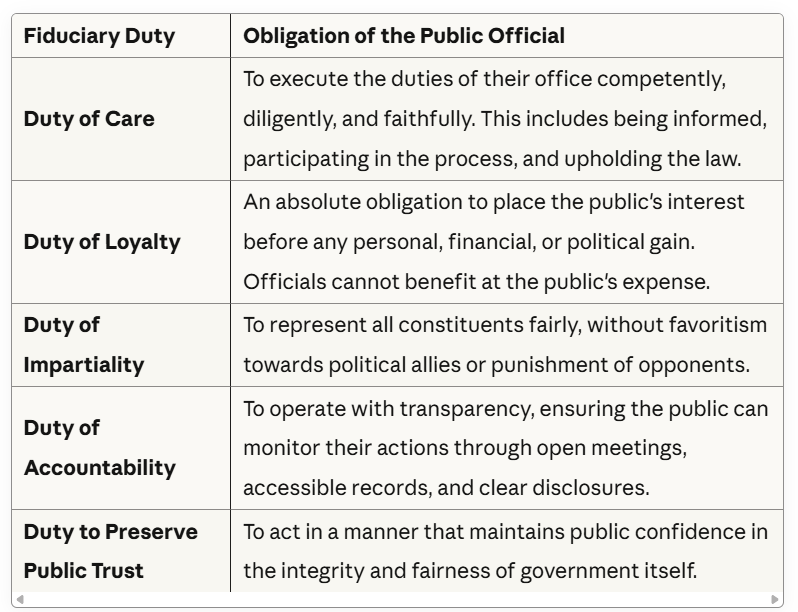
From this fiduciary relationship flow several critical duties that are not just ethical guidelines but the very foundation of legitimate governance. These duties demand that an official’s personal interests never conflict with their public obligations.
When an official uses their position to enrich themselves, reward their allies, or trade favors, they are not merely engaging in “politics as usual”—they are violating the core tenets of their fiduciary duty.
The Oath of Office: A Sacred, Binding Promise
The concept of fiduciary duty is explicitly codified in the oath of office that every Illinois public official must take. Article XIII, Section 3 of the Illinois Constitution mandates the following sworn promise:
“I do solemnly swear (affirm) that I will support the Constitution of the United States, and the Constitution of the State of Illinois, and that I will faithfully discharge the duties of the office of .... to the best of my ability.”
This oath is not a mere formality. It is a binding commitment that transforms a private citizen into a public servant. Breaking it down reveals its profound significance:
“Support the Constitution”: This is a pledge to operate within the rule of law, respecting the limits on governmental power and protecting the rights of citizens.
“Faithfully discharge the duties”: This directly invokes the fiduciary duties of care and loyalty. “Faithfully” implies a commitment to the public good, not personal enrichment.
“To the best of my ability”: This is an acknowledgment of personal responsibility, a promise to apply one’s full effort and judgment to serving the public.
The Illinois Constitution further reinforces these principles by establishing clear consequences for certain criminal acts. Article XIII, Section 1 states that anyone convicted of a “felony, bribery, perjury or other infamous crime” is ineligible to hold public office. This provision directly links criminal corruption to a forfeiture of the right to govern, underscoring that the oath is not just a symbolic gesture but a legal and ethical line that cannot be crossed without severe penalty.
Case Studies in Betrayal: When Oaths and Duties Are Broken
The history of Illinois politics is littered with officials who have treated their oath as a disposable inconvenience and their fiduciary duties as obstacles to personal enrichment. High-profile cases at the state level often grab headlines, but corruption permeates every level of Illinois government—from the Governor’s mansion to county boards to village halls.
Michael Madigan: The Architect of a Corrupt Enterprise
For decades, Michael Madigan was the most powerful politician in Illinois. As Speaker of the House, he wielded immense control over the legislative process. In 2025, his reign culminated in a conviction for racketeering, bribery, and conspiracy, for which he was sentenced to seven and a half years in federal prison.
Breach of Loyalty and Care: The prosecution revealed a scheme where Madigan used his official position to ensure the utility giant ComEd hired his political allies for no-show or low-show jobs. This was a direct trade—in exchange for these financial rewards to his associates, Madigan used his power as Speaker to ensure the passage of legislation favorable to the company. He did not “faithfully discharge the duties” of his office; instead, he used his office to run a corrupt enterprise, placing his personal and political interests squarely above the public good.
Edward Burke: Monetizing Public Power
As a long-serving Chicago Alderman and chairman of the powerful Finance Committee, Edward Burke was convicted in 2023 of racketeering and bribery for using his position to steer business to his private property tax law firm.
Breach of Loyalty and Accountability: Burke wielded his committee chairmanship like a weapon, pressuring businesses seeking city permits and contracts to hire his law firm. He turned the public trust into a shakedown operation, demonstrating that corruption isn’t always about cash in envelopes—sometimes it’s about leveraging government power for private professional gain.
Rod Blagojevich: The Ultimate Quid Pro Quo
Former Governor Rod Blagojevich’s attempt to sell Barack Obama’s vacant Senate seat stands as perhaps the most brazen corruption case in Illinois history. His infamous declaration that a Senate seat “is a valuable thing, you don’t just give it away for nothing” captured on FBI wiretaps, revealed his complete abandonment of his fiduciary role.
Breach of Every Fiduciary Duty: Blagojevich treated a public appointment—one that should have been made based on merit and the public interest—as personal property to be auctioned to the highest bidder. His conviction on corruption charges and 14-year prison sentence (later commuted) underscored how thoroughly he had betrayed his oath.
The Local Corruption Tax: When Small-Town Politics Go Bad
While state-level corruption makes national news, local government corruption in Illinois extracts an equally devastating toll on communities. These cases reveal how the violation of fiduciary duty isn’t limited to Springfield or Chicago—it’s a statewide epidemic.
Rita Crundwell: The $54 Million Theft from Dixon
Rita Crundwell served as comptroller for the city of Dixon for nearly three decades. Over twenty years, she systematically embezzled $53.7 million from the small town of 15,000 residents—one of the largest municipal frauds in American history.
The Scale of Betrayal: Crundwell used her position of trust to create fake invoices and a secret bank account, siphoning city funds to finance an extravagant lifestyle that included a nationally recognized quarter horse breeding operation. While Dixon struggled to maintain basic services, cutting staff positions and deferring infrastructure repairs, Crundwell was spending public money on luxury motorhomes and champion horses.
The Fiduciary Failure: As comptroller, Crundwell had a duty of care to manage Dixon’s finances responsibly and a duty of accountability to maintain transparent records. Instead, she exploited the trust placed in her and the lack of oversight in a small-town government to perpetrate a fraud that devastated the community’s finances for a generation.
Harvey: A City Hall Crime Syndicate
The south suburb of Harvey has been plagued by systematic corruption involving multiple officials. Former Mayor Eric Kellogg was sentenced to prison in 2019 for embezzling more than $400,000 in federal funds meant for Harvey’s water system. His predecessor, Mayor Nickolas Graves, was also convicted of similar charges involving theft of public funds.
Institutional Collapse: This wasn’t one bad actor—it was an entire city government that had abandoned its fiduciary responsibilities. Building inspectors took bribes, contracts were awarded based on kickbacks, and public funds were treated as personal slush funds. The result? Harvey has struggled with basic services, its infrastructure crumbling while officials enriched themselves.
Crestwood: Lying About the Water Supply
In a stunning breach of the duty of care, Crestwood village officials knowingly supplied residents with water contaminated by a closed well for years while publicly denying any problems. When the truth emerged, it revealed that officials had lied to federal regulators and continued using the contaminated well to save money on water purchases.
Public Health Betrayed: Village officials prioritized budget concerns over the health and safety of their constituents, violating their most basic fiduciary obligation. The scandal resulted in federal charges against several officials and a profound loss of trust between the community and its government.
Cicero: Pay-to-Play Paradise
The Town of Cicero has been a corruption hotbed for decades. Former Town President Betty Loren-Maltese was convicted in 2002 of embezzling more than $12 million through a fraudulent insurance scheme. More recently, multiple Cicero officials have faced charges for taking bribes related to red-light camera contracts and other municipal business.
The Culture of Corruption: What makes Cicero’s situation particularly troubling is the persistence of corrupt practices across multiple administrations. When corruption becomes normalized—when officials view bribery and embezzlement as standard operating procedure—it signals a complete breakdown of the fiduciary relationship between government and citizens.
Why Local Corruption Matters Even More
While a corrupt governor or state legislator can cause widespread damage, local corruption often hits citizens even harder. Local governments provide essential services—water, police and fire protection, building permits, road maintenance. When local officials betray their fiduciary duties, the consequences are immediate and personal:
Residents drink contaminated water while officials pocket savings
Infrastructure crumbles while funds are embezzled for personal use
Small businesses face shakedowns for basic permits and licenses
Property taxes rise to cover the costs of theft and mismanagement
Communities lose decades of economic development opportunity
The Dixon case is particularly instructive: Crundwell’s theft cost the city approximately $3,500 per resident. For a small town already struggling economically, this represented an enormous setback that affected every family and business.
The Ripple Effects: How Corruption Destroys Communities
The damage from these betrayals extends far beyond the immediate financial losses. When public officials violate their fiduciary duties:
Economic Development Stalls: Businesses avoid investing in communities known for corruption. Why would a company relocate to a town where officials demand bribes or where public funds mysteriously disappear?
Tax Burdens Increase: Honest taxpayers must make up for stolen funds and the costs of prosecution and recovery. They’re essentially paying twice—once for services they should have received, and again to clean up the mess.
Civic Engagement Collapses: When citizens see that their officials routinely violate their oaths, many become cynical and disengage from civic life. Why vote or participate when the system seems rigged?
Public Services Deteriorate: Money stolen or wasted through corrupt practices isn’t available for schools, roads, public safety, or infrastructure. Communities literally crumble under the weight of corruption.
Breaking the Cycle: What Real Accountability Looks Like
The persistent cycle of corruption in Illinois—from the highest offices in Springfield to the smallest village halls—is more than just a series of isolated criminal acts. It is a systemic failure of public officials to comprehend or respect their fundamental role as fiduciaries for the people they serve.
Breaking this cycle requires fundamental reforms:
Structural Reforms:
Mandatory independent audits for all municipalities, regardless of size
Stronger whistleblower protections for employees who report corruption
Real-time disclosure requirements for campaign contributions and lobbying activities
Limitations on outside employment for officials with discretionary power
Elimination of the ability to hold multiple government positions simultaneously
Cultural Change:
Ethics training that emphasizes fiduciary duty, not just technical rule-following
Celebration of public servants who exemplify integrity
Media coverage that highlights both corruption and ethical leadership
Civic education that teaches citizens their role in demanding accountability
Citizen Engagement:
Active participation in local government meetings and budget reviews
Support for investigative journalism that uncovers corruption
Willingness to report suspicious activity
Voting based on integrity, not just party affiliation or personal relationships
Conclusion: The Trust That Must Be Restored
The cases of Madigan, Burke, Blagojevich, Crundwell, and countless local officials who have violated their oaths are not anomalies—they are symptoms of a political culture where the solemn oath of office is too often regarded as a hollow ritual and public service is seen as a pathway to personal wealth and power.
Every public official in Illinois, whether they preside over the state legislature or a small village board, takes the same oath. They all promise to faithfully discharge their duties. They all accept a fiduciary responsibility to place the public interest above their own.
The question Illinois must confront is this: Will we continue to tolerate a system where these promises are routinely broken, or will we demand that our officials—at every level of government—actually honor the trust we place in them?
Until Illinois officials begin to take their fiduciary responsibilities and their oaths of office seriously, the state will remain trapped in a shadow of its own making, and the public will continue to pay the price—in wasted tax dollars, deteriorating services, lost opportunities, and the slow erosion of faith in democratic governance itself.
The solution begins with a simple but profound expectation: that every person who takes an oath to serve the public actually means it. And that when they don’t, there are real consequences—not just from federal prosecutors, but from the citizens who entrusted them with power in the first place.
References
[1] Illinois Policy. (2022, December 26). Feds targeted these Illinois politicians for corruption in 2022.
[2] Santa Clara University, Markkula Center for Applied Ethics. Public Officials as Fiduciaries.
[3] Illinois General Assembly. Illinois Constitution - Article XIII.
[4] U.S. Department of Justice. (2025, June 13). Former Illinois Speaker of the House Michael J. Madigan Sentenced to Seven and a Half Years in Prison After Corruption Conviction.
[5] U.S. Department of Justice. (2023, December 21). Former City of Chicago Alderman Convicted on Federal Racketeering, Bribery, and Extortion Charges.