

Burr Ridge and Decatur have approved remarkably similar five-year expenditures for Flock Safety camera systems.
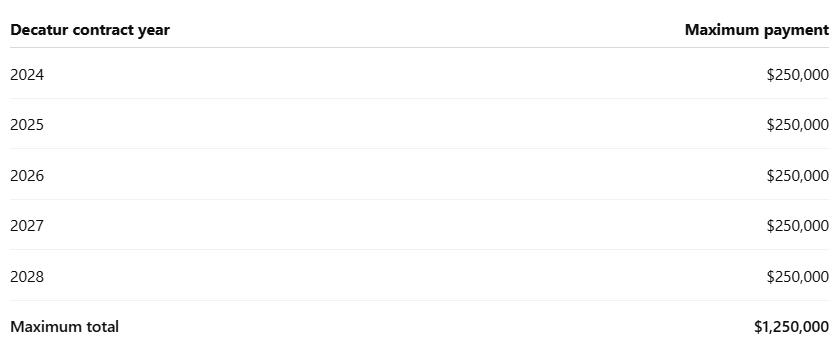
Decatur authorized up to $1.25 million for 100 automated license-plate readers covering 2024 through 2028.
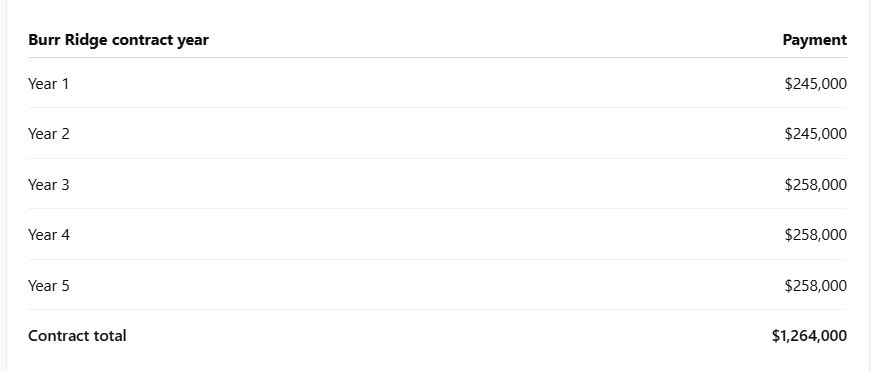
Burr Ridge subsequently approved a $1.264 million agreement covering August 2026 through August 2031.
Burr Ridge’s contract is $14,000 larger.
But the communities are nowhere near the same size.
The U.S. Census Bureau estimated Decatur’s 2025 population at 67,884. Burr Ridge’s estimated population was 11,179. Decatur therefore has slightly more than six times as many residents.
The comparison does not establish that Burr Ridge overpaid. The municipalities purchased different combinations of products and services. But it raises a basic question of scale: Why does a small, low-crime suburb require a Flock system costing slightly more than one approved for a city six times its size?
Nearly identical five-year totals
In November 2023, the Decatur City Council approved a five-year extension with Flock Safety for 100 license-plate-reading cameras in city neighborhoods and along adjacent thoroughfares.
The authorization allowed annual payments of up to $250,000 in each of five years:
The complete resolution is available through the City of Decatur’s public meeting system.
Burr Ridge’s agreement requires:
The Burr Ridge order form, product descriptions, payment schedule and subdivision-camera policy begin on packet page 67 of the Village’s July 13, 2026 board packet.
The contracts are not identical
Decatur’s resolution identifies 100 Flock license-plate readers. It does not provide the full product detail contained in Burr Ridge’s order form.
Burr Ridge’s order form includes four groups of license-plate readers with quantities totaling 81. It also lists 53 solar video-camera units, Advanced Search, electrical services, poles and related implementation work.
The Advanced Search package includes visual search, searches across multiple geographic areas and convoy analysis. The Flock platform also offers access to statewide and nationwide license-plate searches, custom hotlists and other participating law-enforcement and private-camera networks.
The broader Burr Ridge package may explain some of the difference in cost.
It also raises another question: Why did Burr Ridge choose a system with such expansive capabilities?
The per-resident difference
Using the Census Bureau’s 2025 population estimates, the five-year contract totals equal approximately:
Burr Ridge: $113 per resident
Decatur: $18 per resident
Expressed annually, Burr Ridge’s agreement averages approximately $22.61 per resident per year. Decatur’s maximum authorization averages approximately $3.68 per resident per year.
Those figures are not tax bills, and they do not account for grants, reimbursements or other revenue. They illustrate the relative scale of each municipality’s commitment.
Burr Ridge’s order form also lists approximately 72 license-plate readers for every 10,000 residents. Decatur’s authorization equals approximately 15 readers for every 10,000 residents.
Burr Ridge therefore contracted for nearly five times as many license-plate readers per resident, before counting its solar video-camera units.
Crime was already falling in Burr Ridge
Burr Ridge’s own 2025 Crime and Incident Data Report documented 248 Group A criminal offenses.
Property crime fell 5% from 2024. Burglaries declined from 36 to 12—a 67% reduction. Theft and fraud also fell.
The report said Burr Ridge’s increased police activity was “driven by proactive patrol, not rising crime.”
That does not mean cameras provide no value. Burr Ridge sits near major highways, commercial areas and affluent residential neighborhoods. Police may use license-plate readers to locate stolen vehicles, identify vehicles connected to burglaries and develop investigative leads.
But the Village’s declining crime figures make it especially important to define what additional benefit the expanded system is expected to deliver.
The board materials do not establish public performance targets for reducing burglaries, recovering vehicles, clearing cases or responding to missing-person incidents.
Who will pay?
Burr Ridge staff told the Village Board that the program’s projected “net cost” would be approximately $70,000 annually.
That figure is far below the contract’s annual payments of $245,000 to $258,000, and the packet does not provide a calculation reconciling the difference.
One expected revenue source is the subdivision-camera program.
Participating homeowners associations will pay Burr Ridge $1,750 per camera annually after receiving their first year without charge. Flock charges the Village $3,500 annually for each new subdivision camera, leaving the Village to subsidize the other half.
Burr Ridge reported that at least seven subdivisions had expressed a willingness to participate. The packet does not identify them, state how many cameras each requested or show the amount of anticipated HOA revenue included in the $70,000 projection.
It is therefore unclear how much of the $1.264 million will ultimately be paid from general Village revenue and how much Burr Ridge expects to recover from homeowners associations or other sources.
Different cities, different needs
A direct comparison between municipal technology contracts is never perfect.
Cities differ in geographic area, road configuration, crime patterns, staffing, existing equipment and the specific technology included in an agreement. Decatur covers approximately 43 square miles, while Burr Ridge covers about seven. Decatur’s resolution identifies 100 LPR cameras, while Burr Ridge’s order includes both LPR and video products.
But scale still matters.
Decatur is responsible for policing a substantially larger population and geographic area. Burr Ridge committed slightly more money and contracted for a much denser camera network on a per-resident basis.
The comparison should prompt Burr Ridge officials to explain why this particular system—and this particular level of expenditure—is appropriate for the Village.
What should be measured
Burr Ridge should report whether the expanded system produces results that justify its cost.
Useful measures would include:
Number of license-plate searches
Number of real-time alerts
Stolen vehicles recovered
Missing or endangered people located
Arrests resulting from camera information
Cases materially advanced or cleared
False or outdated alerts
Cameras unavailable because of maintenance problems
Searches conducted by outside agencies
Confirmed policy violations
Total annual cost after HOA payments and other revenue
Cost per successful investigative outcome
Without those figures, residents are left comparing contract prices and general assurances rather than measurable public-safety results.
The question is proportionality
Burr Ridge may conclude that its location, road network and property values justify more cameras per resident than a larger city.
If so, officials should present that analysis publicly.
The Village has committed $1.264 million over five years to a system capable of recording vehicles, issuing alerts, searching physical characteristics and accessing information through wider camera networks.
Decatur, with six times the population, authorized slightly less for its five-year Flock program.
That does not prove Burr Ridge made the wrong decision.
It does mean taxpayers deserve a much clearer explanation of why Burr Ridge needs a surveillance system of this size—and how the Village will determine whether it was worth the money.
Questions to Ask
Why does Burr Ridge require nearly five times as many LPR cameras per resident as Decatur?
What public-safety analysis determined that Burr Ridge needed 81 LPR entries and 53 solar video-camera units?
What portion of the $1.264 million will be paid by the General Fund?
How much revenue does Burr Ridge expect from homeowners associations?
How was the projected $70,000 annual net cost calculated?
What measurable results must the system produce to justify renewal?
Will Burr Ridge publish annual cost and performance reports?
Will the Village reconsider the number of cameras if crime remains low or continues declining?
Sources
Burr Ridge Village Board Packet and Flock Order Form—July 13, 2026
Burr Ridge Police Department 2025 Crime and Incident Data Report
How we made this: CityNewsWire compared Burr Ridge’s July 13, 2026 Flock order form and payment schedule with Decatur’s 2023 resolution authorizing its five-year Flock extension. Population figures are the U.S. Census Bureau’s July 1, 2025 estimates. Burr Ridge crime figures come from the Police Department’s 2025 Crime and Incident Data Report. Because Decatur’s resolution does not provide the same product-level detail as Burr Ridge’s order form, the comparison identifies differences in the available records rather than treating the two purchases as identic