

A few years ago, a local-government camera purchase was relatively easy to understand.
The police department bought body cameras. Or license-plate readers. Or cameras for a municipal building.
Each purchase had a purpose, a vendor and a contract.
That model is changing.
Records from Illinois municipalities show police agencies increasingly buying something more consequential: the technology that connects all of those systems together.
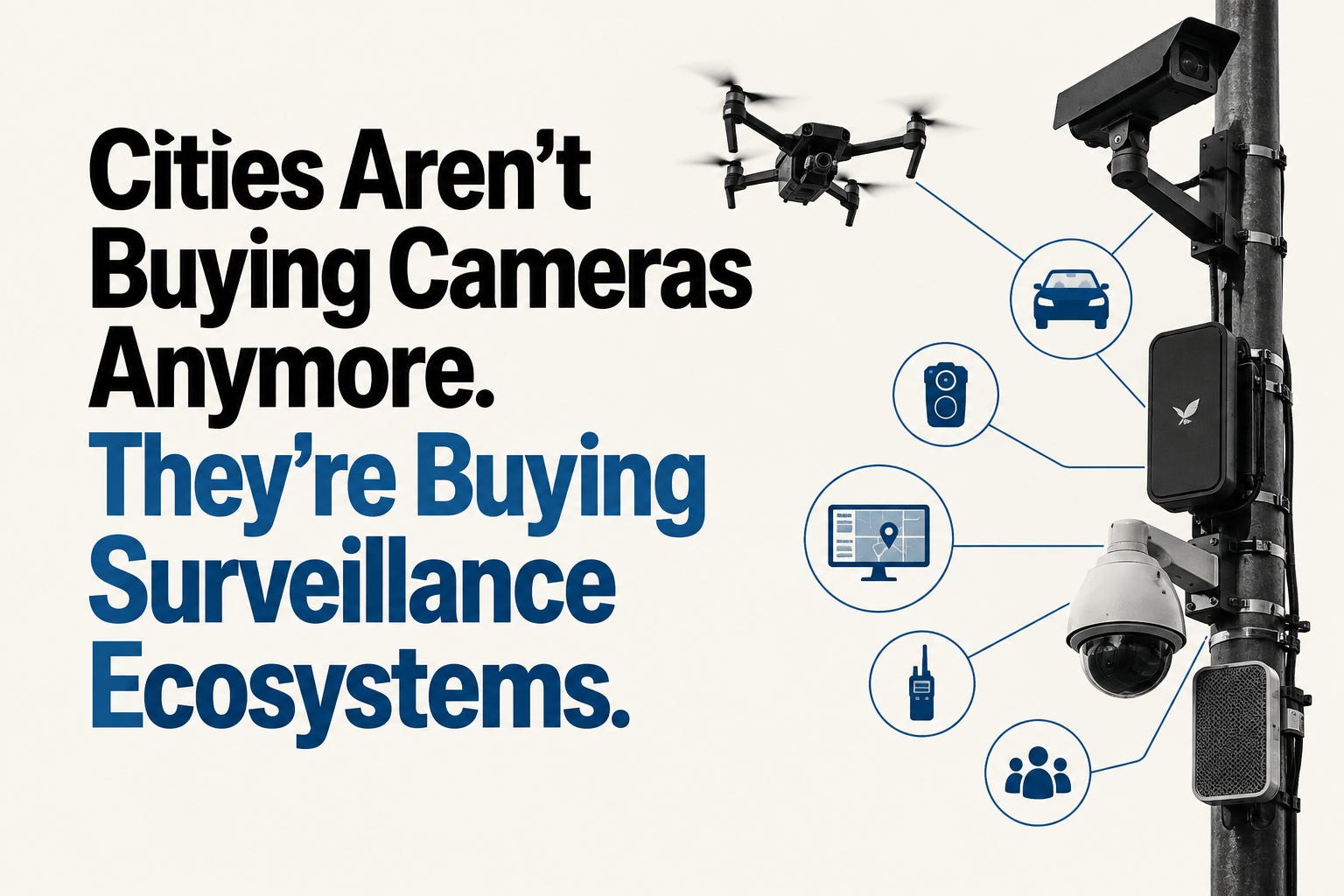
Computer-aided dispatch. Police reports. Body cameras. Squad-car cameras. License-plate readers. Drones. Gunshot sensors. City-owned cameras. Privately owned business cameras. Digital evidence.
Instead of existing as separate tools, they can increasingly appear on the same screen.
The industry calls this a real-time crime center, real-time information center or “common operating picture.”
The result is a different kind of public-safety infrastructure.
The camera is becoming only one sensor inside a much larger system.
Aurora was already building the model three years ago
Aurora provides one of the clearest Illinois examples.
In 2023, the city approved a five-year Fusus subscription for its police department at a cost of $666,328 plus a 10% contingency.
Aurora’s procurement documents explain exactly why.
Its police intelligence center was already using multiple systems: the Hexagon computer-aided dispatch platform, Axon squad-car and body cameras, ShotSpotter, automated license-plate readers and hundreds of public and privately owned cameras.
The problem, according to the city, was that employees had to move between separate applications.
Fusus promised to put those systems into a single interface.
The purchase agreement contemplated more than merely displaying video. It included integration of existing and future video feeds, CAD information, automatic vehicle-location data, drones, covert cameras and license-plate readers. The platform also included tools designed to follow vehicles and people from one camera to another.
Then Aurora began connecting more pieces.
In 2024, the city approved Motorola license-plate-reader hosting and an integration specifically designed to transfer that data into Fusus. City records said Aurora was already using Motorola LPR services and had purchased its own LPR equipment; Fusus would give officers access to searches and alerts within the broader platform.
The city separately reached an agreement allowing police access to surveillance cameras at Chicago Premium Outlets through Fusus.
Aurora renewed ShotSpotter in 2025 for another three years at $420,000.
And now drones are entering the picture.
In August 2026, Kane County approved an agreement with Aurora for a Drone as First Responder pilot. The county had leased the drone platform and software on a trial basis from Flock Safety, while Aurora agreed to provide pilots and operational support.
Put those purchases together and the change becomes easier to see.
Aurora did not simply buy a camera system.
It created an information layer capable of bringing together products and data from Axon, Motorola, SoundThinking, Fusus, Flock and privately owned cameras.
That is the ecosystem.
Naperville bought the layer that sits above the systems
Naperville made a similar move this year — but chose a different company.
In March, the City Council approved a $556,400, three-year contract with Peregrine Technologies for Real-Time Information Center software.
Naperville’s explanation is unusually clear.
The police department already had dispatch information, police records and fixed and mobile camera systems. But they operated independently.
Peregrine would connect those sources so authorized employees could search, analyze and visualize information through one system.
Joliet reached the same conclusion.
In February, Joliet approved Peregrine after describing a police department in which Axon and Motorola records systems, 911 dispatch, video evidence, license-plate readers and administrative programs were operating independently.
The city described Peregrine as an integration layer providing a “single pane of glass” from which officers could query multiple systems at once.
That phrase — single pane of glass — is important.
The new product being sold to cities isn’t necessarily another camera.
It is the screen through which all the other cameras and databases become more useful together.
Naperville almost went much further
Naperville provides another important example because this month its City Council said no to a separate, much larger proposal.
City staff sought approval for an $8.29 million citywide camera and access-control contract with SDI Presence.
The project would have replaced about 200 aging cameras and added approximately 270 new cameras. It also proposed replacing roughly 400 building-access readers, adding about 90 new access points and moving the city’s existing systems into a centralized Genetec security platform.
But the most revealing part of the proposal may have been who would operate it.
City staff proposed a managed-service arrangement in which a private contractor would provide 24-hour monitoring, maintenance and support for the security network.
The agenda memo said the city’s preferred approach was for the managed-service provider to support and “own” the full network because the city did not have the specialized in-house expertise needed to maintain it.
The council rejected the proposal 6-2 on September 1. Local reporting said council members raised concerns about both its cost and residents’ concerns over privacy and surveillance.
That vote is important because it demonstrates that these systems are not inevitable.
Municipal officials still decide how large they should become, which capabilities should be connected, how much should be outsourced and how much taxpayers should spend.
Naperville is still moving forward with other real-time technology. Its 2026 budget included $150,000 for a Drone as First Responder initiative, and city documents describe drones capable of launching toward certain calls within about 15 seconds and streaming video back to responders.
The city has therefore approved some pieces, rejected another and continues to evaluate others.
That may become increasingly common as public-safety technology stops arriving as one easily understood purchase.
Evanston bought an Axon package stretching across police operations
Evanston provides perhaps the clearest example of what happens when many parts of police technology come from the same company.
The City Council approved a seven-year Axon agreement in December 2025 totaling about $5.85 million.
Evanston originally began buying Axon body cameras in 2017. It later expanded into Axon’s Evidence.com storage system, automated video redaction and an internal-affairs case-management product.
The new package is much broader.
City documents describe body cameras, fleet cameras, interview-room cameras, Taser 10 devices, unlimited digital evidence storage, redaction software, internal-affairs software and integration with the Axon Fusus real-time crime center platform.
The associated Axon proposal also lists drone technology, including Skydio patrol/DFR equipment, drone docks and DroneSense licenses, along with Fusus hardware capable of connecting additional CCTV streams.
That is not a camera contract in the traditional sense.
It is increasingly an operating environment for police work.
Axon itself describes Fusus as a system that brings officer locations, alerts, dispatch information, ALPR data and video feeds together on a common map. It also supports privately owned cameras that businesses or residents choose to share with police.
Axon acquired Fusus in 2024 for approximately $241 million for the remaining equity it did not already own. In its federal filings, Axon said the acquisition expanded its ability to aggregate video, sensor and other data as part of its public-safety offerings.
The company now openly describes its products as an end-to-end public-safety ecosystem.
Geneva’s records show what “ecosystem” can mean for competition
Geneva provides another angle that deserves more attention.
This summer, the city considered a 10-year, $1.254 million Axon agreement.
The package included 38 body cameras, 10 Fleet 3 vehicle systems, Tasers, digital-evidence storage and supporting software. The vehicle package included ALPR capabilities, real-time location and livestream functions. The proposal also included Community Link and Fusus livestream access.
During the review, someone asked an obvious procurement question:
Was 10 years too long to remain tied to one vendor, particularly in a rapidly changing technology market?
The city’s written response is revealing.
Geneva said it had not sought alternative pricing from other vendors, although it had reviewed cooperative-purchasing evaluations.
It also explained that switching away from Axon would be expensive because the existing body-camera system was already tied into dispatch systems, software, vehicle hardware, building wiring, staff equipment, training and FOIA redaction procedures.
“A new system change,” the city said, would require “a substantial investment of time and money.”
That is the other side of integration.
Connecting everything can make police work easier.
It can also make changing vendors harder.
The more body cameras, evidence storage, vehicle cameras, drones, redaction tools and real-time systems depend upon one another, the less a future procurement resembles simply replacing a camera.
A city may have to replace an ecosystem.
Even privately owned cameras can become part of it
The University of Illinois Police Department launched its Community Connect program in July.
Powered by Axon Fusus, it allows residents and business owners to register private security cameras so police know where potential footage may exist after an incident.
The university’s Real-Time Information Center also links to separate public transparency portals for its Flock license-plate readers and Skydio drones.
Fusus can go further than a simple camera registry.
Axon says participating businesses and residents can choose to connect camera feeds directly to police, with sharing rules controlled by the camera owner. Those feeds can then appear alongside government cameras and other public-safety information in the same operational platform.
That means the size of a municipal camera system can no longer always be determined by counting cameras purchased by city hall.
Some of the available network may belong to stores, schools, shopping centers, apartment buildings or residents.
Flock is moving in the same direction
This trend isn’t limited to Axon.
Flock increasingly markets its own real-time crime center platform as the place where agencies can combine 911 information, video, license-plate readers, drones, gunshot detection and other data.
The company also advertises integration of cameras belonging to schools, HOAs and businesses.
So while much of the current national debate has focused on Flock license-plate readers, the larger public-policy question is moving beyond any single company’s cameras.
The industry is heading toward integration.
Flock wants to connect the information.
Axon wants to connect the information.
Peregrine sells the integration layer.
Other vendors supply the individual sensors.
And Illinois local governments are already assembling combinations of all of them.
The procurement question has changed
A council agenda item titled “camera purchase” tells residents roughly what government wants to buy.
A contract for a real-time information platform may be much harder to understand.
The city may not be purchasing a new camera at all.
It may be purchasing the ability to connect cameras, police records, dispatch information, private video, license-plate detections and drones that already exist.
That changes the questions elected officials should be able to answer.
What systems will be connected on Day One?
What systems can be connected later without another major council vote?
Who decides which private cameras enter the network?
Can employees search across multiple databases at once?
Are those searches logged?
What information can neighboring agencies see?
How long is data retained in each underlying system?
If one company stores the evidence, supplies the cameras, provides the integration software and manages other police technology, how difficult is it to switch vendors?
And if new AI capabilities are introduced during a five-, seven- or ten-year contract, what requires another public discussion?
Those aren’t arguments that integration has no value.
Police agencies have given concrete reasons for wanting it: fewer screens, faster access to evidence, better information for officers responding to emergencies and less time spent manually moving among disconnected systems. Aurora, Joliet and Naperville all made versions of that case in their own procurement documents.
But integration changes what a technology purchase means.
The public debate over Flock has largely been about cameras.
Illinois procurement records suggest the next debate may need to be about something bigger:
the infrastructure that connects the cameras to everything else.
How this story was made
CityNewsWire reviewed municipal procurement records, council agendas, contracts and supporting materials from Aurora, Naperville, Joliet, Evanston and Geneva; records from Kane County and the University of Illinois Division of Public Safety; and current product information from Axon and Flock Safety.
CityNewsWire distinguished between systems that have been approved and implemented, proposed systems that were rejected, and capabilities vendors advertise but that an individual Illinois agency may not have activated. Vendor descriptions of safety, efficiency and product capabilities are identified as vendor or government claims rather than independent measures of program effectiveness.
Sources
Aurora — Fusus Real-Time Crime Center contract and integrations Aurora City Council Fusus procurement
Aurora — Motorola LPR/Fusus integration Aurora LPR hosting and integration records
Aurora — Chicago Premium Outlets camera-sharing agreement Aurora private-camera agreement
Kane County — Aurora Drone as First Responder agreement Kane County Resolution 26-350
Naperville — Real-Time Information Center/Peregrine contract Naperville RTIC procurement
Naperville — proposed $8.29 million citywide camera system Naperville Citywide Camera Access proposal
Joliet — Peregrine data-integration contract Joliet Peregrine procurement
Evanston — Axon public-safety technology agreement Evanston Axon contract materials
Geneva — Axon contract and vendor-lock-in discussion Geneva Committee of the Whole responses
University of Illinois — Community Connect/Fusus University of Illinois Community Connect announcement
Axon — Fusus real-time operations platform Axon Fusus
Flock Safety — Real-Time Crime Center platform Flock Real-Time Crime Center