A company approaches City Hall with a development proposal.
It may use a code name. Officials may sign a nondisclosure agreement before discussing the site, incentives, utility needs or other details.
Then a resident or reporter asks for the agreement.
The answer sounds definitive:
Confidential.
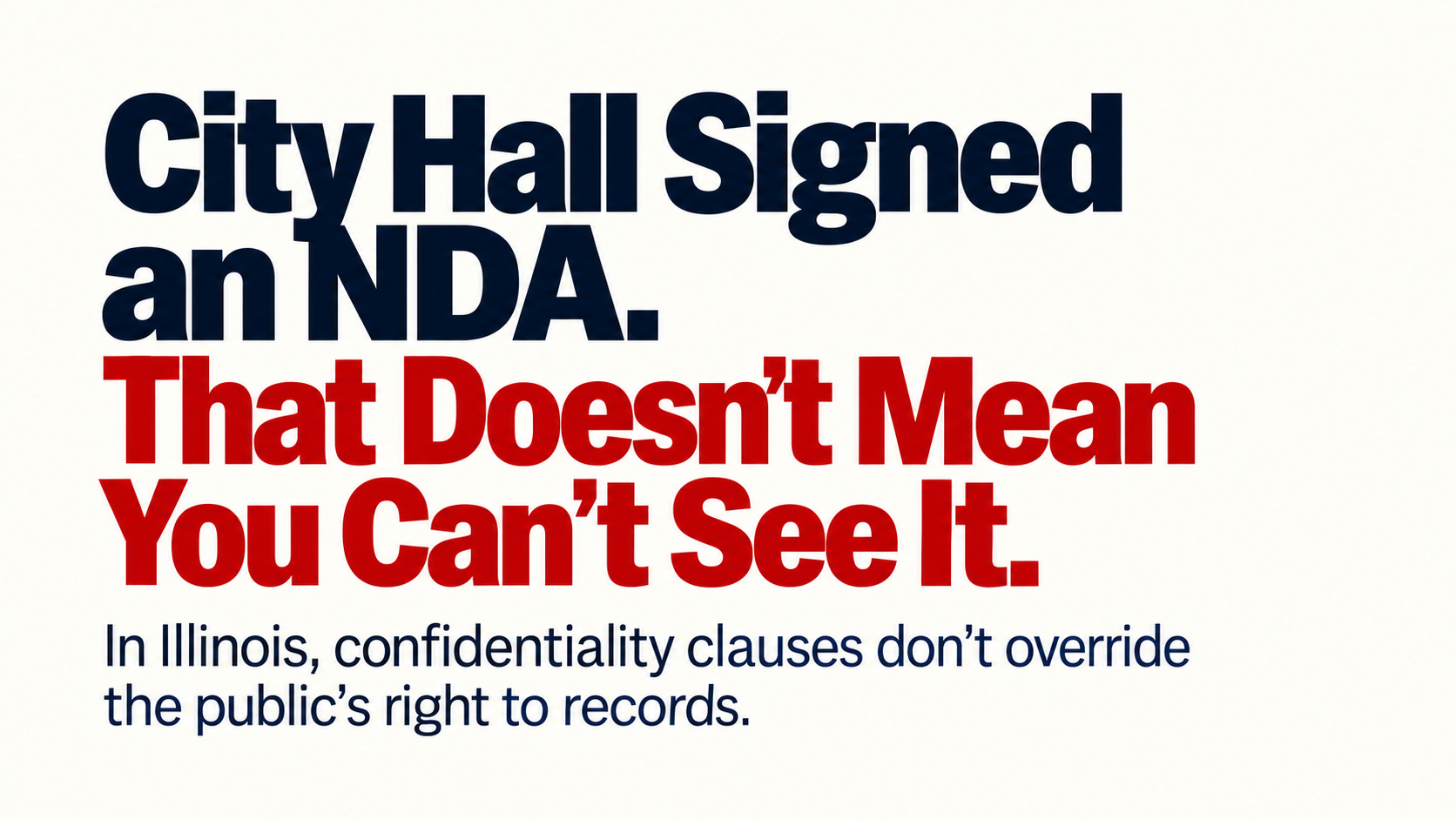
Except in Illinois, writing “confidential” on a document does not make it exempt from the Freedom of Information Act.
Neither does signing an NDA.
The Illinois Attorney General made that unusually clear in a 2023 case involving the City of DeKalb and Kraft Heinz.
And the ruling matters well beyond one distribution center.
It matters anywhere local officials are negotiating privately with data centers, developers, manufacturers and other companies while decisions involving public land, infrastructure, incentives or taxpayer money are taking shape.
DeKalb had an NDA with Kraft Heinz
In July 2023, Daily Chronicle reporter Megann Horstead requested a copy of an NDA between DeKalb and Kraft Heinz concerning a development project known as “Supernova.”
The city denied the request.
DeKalb relied on an Illinois FOIA exemption protecting certain trade secrets and confidential commercial or financial information. The city pointed out that the NDA itself required confidentiality and argued that Kraft Heinz customarily treated the information as private.
At first glance, that sounds like a strong argument.
It wasn’t enough.
The Illinois Attorney General’s Public Access Counselor issued Binding Opinion 23-015 and found that DeKalb had violated FOIA by withholding the agreement. The opinion is now listed in the Attorney General’s FOIA index under a fairly blunt description: a nondisclosure agreement concerning an already announced commercial development was not exempt under the commercial-information exemption.
“Confidential” is only part of the test
Illinois FOIA does protect some commercial information.
Section 7(1)(g) covers trade secrets and commercial or financial information when it was supplied under a claim that it was proprietary, privileged or confidential and disclosure would cause competitive harm.
That last requirement mattered in DeKalb.
The Attorney General concluded that the NDA involved a commercial project and had been provided under a confidentiality claim.
So Kraft Heinz and the city cleared those parts of the test.
What they did not establish was that releasing the NDA would cause competitive harm.
The Attorney General noted that the agreement largely consisted of standard confidentiality provisions. It did not reveal sensitive details such as Kraft Heinz’s business strategies, expenses, revenues or specific plans for the distribution center.
There was another problem.
By the time the reporter requested the NDA, Kraft Heinz had already publicly announced the DeKalb project.
The Attorney General’s 2023 annual report explains the logic: disclosing an NDA could not reveal the existence of negotiations when the company had already announced the development itself.
DeKalb was ordered to release the agreement.
A private agreement cannot rewrite Illinois FOIA
That principle appears elsewhere in Illinois transparency law.
The Attorney General’s binding-opinion index includes decisions finding that:
negotiated terms of contracts with public bodies do not automatically constitute trade secrets;
financial terms, invoices and budget records involving public funds are not exempt merely because a company considers them commercial;
a public body cannot withhold information concerning money it spends or receives under agreements with private entities;
confidentiality clauses in public settlement agreements cannot defeat FOIA disclosure requirements.
In a 2015 binding opinion involving Rosemont, the Attorney General specifically concluded that negotiated contract terms with public bodies do not become trade secrets simply because the private party wants them treated that way.
Illinois’ Attorney General also tells public bodies in its current FOIA training that the presence of a confidentiality clause in a settlement agreement does not supersede FOIA.
The underlying principle is simple:
Government cannot create a new FOIA exemption by signing a contract.
The exemptions come from law.
That does not mean every NDA must be released
There is an important limit.
The DeKalb opinion does not say every document exchanged under an NDA is automatically public.
Real trade secrets and genuinely sensitive commercial or financial information may qualify for protection.
A company could, for example, have information whose disclosure would actually damage its competitive position.
FOIA itself recognizes that possibility.
The distinction is between demonstrating an exemption and merely asserting confidentiality.
Calling something proprietary is not the same as proving that disclosure would cause the harm required by the statute.
In DeKalb, the Attorney General said Kraft Heinz’s assertions of competitive harm were too vague and conclusory.
That is a much higher bar than:
“We signed an NDA.”
That distinction matters for development deals
Nondisclosure agreements are particularly consequential when local governments negotiate major development projects.
Residents may not initially know:
who the developer is;
what property is being discussed;
how much electricity or water a project could require;
whether tax incentives are being considered;
what infrastructure taxpayers may be asked to provide;
or what commitments officials are discussing before a project reaches a public meeting.
Some information may legitimately remain confidential during negotiations.
Illinois law itself contains exemptions for certain ongoing real-estate negotiations and procurement matters.
But an NDA does not turn the entire relationship between government and a developer into a private one.
And once a project becomes public, the rationale for withholding some information can change.
That is exactly what happened in DeKalb.
The question isn’t whether an NDA exists
For residents seeking records about a development, the better question is:
What specific Illinois FOIA exemption applies to this specific information — and how would disclosure cause the harm that exemption requires?
That forces the analysis back where it belongs.
Not on what City Hall promised a corporation.
Not on a “CONFIDENTIAL” stamp.
Not on a code name.
On the law.
An NDA may govern what a company and a city voluntarily say to one another.
It does not give either party the power to rewrite the Illinois Freedom of Information Act.
How this story was made
We reviewed the Illinois Attorney General’s current Index of FOIA Binding Opinions, Public Access Opinion 23-015 involving the City of DeKalb and Kraft Heinz, the Attorney General’s 2023 Public Access Counselor annual report, other Illinois binding opinions concerning confidentiality, contracts and public funds, and the current text of the Illinois Freedom of Information Act.
This story describes general Illinois public-records principles and does not conclude that every NDA or every document exchanged under an NDA must be disclosed. Individual records may qualify for statutory exemptions depending on their contents and circumstances.
Sources
Illinois Attorney General — Public Access Opinion 23-015: City of DeKalb/Kraft Heinz NDA Read the binding opinion
Illinois Attorney General — Index of FOIA Binding Opinions
Illinoi
s Attorney General — 2023 Public Access Counselor Annual Report
Illinois Attorney General — Public Access Opinion 15-002: negotiated public contracts and trade secrets
Illinois Attorney General — FOIA Training for Public Bodies
Illinois General Assembly — 5 ILCS 140/7, FOIA exemptions