

Across Illinois, police departments and sheriff’s offices have been responding to a public-records project seeking information about when, where and how officers use force.
The requests were filed through MuckRock by police-accountability researcher Samuel Sinyangwe. Of the first 100 Illinois requests displayed on Sinyangwe’s MuckRock page, 81 were marked “Completed” when CityNewsWire reviewed the list.
Completed requests included departments in La Grange, Mokena, Willowbrook, Palos Heights, Hickory Hills, Bellwood, Highland and Fairview Heights. Larger agencies in Elgin, Peoria, Joliet, Rockford and Springfield also completed recent requests.
North Chicago did not.
MuckRock categorizes its North Chicago request as “No Responsive Documents.”
That result becomes more difficult to understand when compared with records North Chicago produced in response to earlier requests concerning excessive-force complaints, police litigation and settlements.
Those records include a risk-management summary listing nearly $3.9 million in police-related loss payments—and an executed $385,000 settlement arising from a 2017 arrest that was the subject of an excessive-force lawsuit.
What was requested
The request sought North Chicago Police Department use-of-force data covering January 1, 2017, through December 31, 2025.
It asked for a database or spreadsheet, if one existed, containing information such as:
Case number, date, time and location
Type of force used
Whether the person was injured
The person’s age, gender and race or ethnicity
Whether a weapon was involved
Names and badge numbers of participating officers
But the request did not depend upon a spreadsheet existing.
It specifically said that if no database or spreadsheet was available, the department should provide individual use-of-force reports or other reports in which officers documented force.
The request was submitted through MuckRock on May 12, 2026. The letter is dated May 13, and North Chicago’s copy bears a May 26 receipt stamp. The city assigned it reference number 26-306.
North Chicago’s response consisted of two sentences:
“We do not maintain that particular data in document form, and we are not required to create a new document in response to this request. This FOIA request is now closed.”
The response did not identify what record systems or files had been searched.
It did not say whether North Chicago officers completed individual use-of-force reports during the nine-year period. It did not address arrest reports, incident reports, supplemental narratives, supervisory reviews or reports submitted to the Illinois State Police.
Refusing to create a spreadsheet is not the entire answer
Illinois public bodies generally are not required to create a new record solely to answer a Freedom of Information Act request.
If North Chicago did not have the requested spreadsheet, the city would not necessarily have to build one.
But Sinyangwe anticipated that possibility. He also requested the existing underlying reports.
The city’s response addressed the creation of a new document but did not clearly address that alternative.
The distinction is significant. Saying a department does not maintain a compiled dataset is not the same as saying it searched for individual records and found none.
If individual records exist, the question is why they were not produced or addressed. If they do not exist, the question becomes how North Chicago documented, reviewed and supervised officers’ uses of force.
North Chicago produced police-loss records in another request
In August 2025, a different requester sought all North Chicago settlements resulting from Police Department actions from 2010 forward. The request specifically included settlements involving deaths, injuries, excessive force, retaliation, harassment and other claims.
Documents posted with the completed MuckRock settlement request include a risk-management summary listing seven police-related losses:
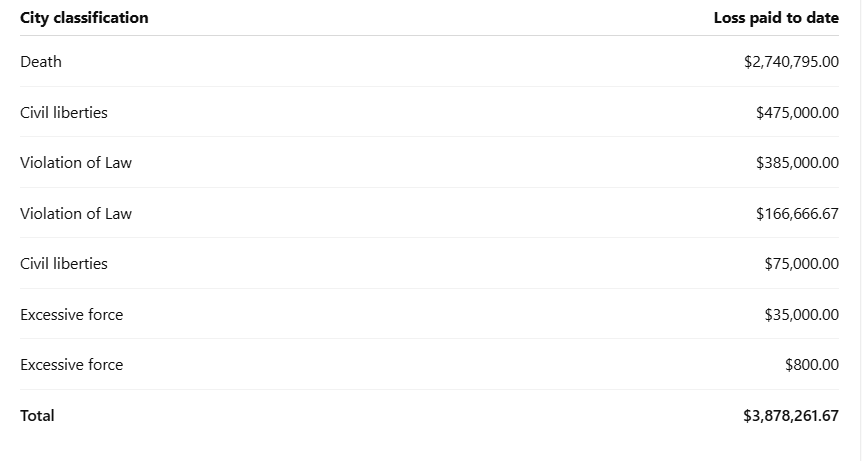
The summary describes the amounts as “loss paid to date.” It does not establish that every dollar came directly from North Chicago taxpayers. Some payments involved insurers, risk-management pools or multiple municipalities. The listed matters also include employment and wrongful-incarceration litigation, not only excessive-force claims.
But the records demonstrate that the city and its claims administrators maintained detailed documentation of police-related incidents, lawsuits and payments.
A $385,000 settlement falls squarely within the requested period
The most relevant record is the settlement with Jonathan Garcia.
Garcia filed a federal civil-rights lawsuit against North Chicago, several officers and other defendants following his arrest and booking on September 1, 2017.
The settlement agreement provided:
$175,000 to Garcia
$210,000 for attorneys’ fees and costs
$385,000 total
The city and officers denied liability, and the settlement expressly stated that it was not an admission of wrongdoing.
Garcia’s lawsuit nevertheless alleged excessive force, failure to intervene, supervisory liability and a municipal failure to discipline, monitor, supervise and retrain officers. A federal court allowed Garcia’s municipal-liability claim to proceed together with his claims against the individual officers. Read the federal court’s Garcia decision.
The September 2017 incident falls directly within the period covered by Sinyangwe’s request.
Curiously, North Chicago’s loss summary classified the $385,000 payment as a “violation of law,” rather than “excessive force.”
The settlement agreement is not itself an officer’s use-of-force report, and the lawsuit does not prove that such a report was completed. But the incident was documented extensively enough to produce a federal civil-rights case, discovery, a municipal-liability claim and a substantial settlement.
Did North Chicago officers prepare an arrest report, incident report, supplemental report or use-of-force form concerning that encounter? If they did, was it searched in response to FOIA request 26-306?
The city’s response does not say.
Another settlement involved a 2018 arrest and detention
North Chicago also produced a $75,000 settlement agreement with Darrell Haywood arising from his September 12, 2018 arrest and detention at the North Chicago Police Department.
Haywood’s federal civil-rights action named the city and four officers. As with Garcia, the city and officers denied liability, and the settlement was not an admission that the allegations were true.
North Chicago’s risk-management summary classified this payment as a civil-liberties matter.
Again, the settlement does not prove the existence of an officer-generated use-of-force report. It does establish another police encounter, civil-rights lawsuit and settlement during the exact period covered by Sinyangwe’s request.
Illinois requires monthly reporting—or a zero report
The state’s reporting requirements make North Chicago’s response even more puzzling.
Effective January 31, 2022, Illinois law-enforcement agencies have been required to submit monthly use-of-force reports to the Illinois State Police through the state’s incident-based reporting repository.
The rule applies to force resulting in death, serious bodily injury or the discharge of a firearm at or in the direction of a person.
If an agency has no qualifying use-of-force incidents during a month, it must submit a zero report by the fifteenth day of the following month.
In other words, for the portion of Sinyangwe’s request beginning in 2022, North Chicago should have reported qualifying incidents—or affirmatively reported that it had none. Read 20 Illinois Administrative Code §1244.30.
The state reporting rule is narrower than Sinyangwe’s request. It does not cover every physical restraint, Taser deployment, strike or other lower-level use of force. It also does not conclusively establish that North Chicago retained a local copy of every state submission.
But it raises an obvious question the city’s FOIA response did not answer: Did North Chicago search for the reports or zero reports it submitted to the Illinois State Police?
If those records are maintained only by the state, the city could have explained that. Instead, it closed the request after saying it did not maintain “that particular data in document form.”
The department says it archives its reports
North Chicago’s own 2025 Police Department annual report describes a department with formal recordkeeping and administrative-review systems.
According to the report, the Records Unit “processes and archives all reports of criminal, non-criminal, and traffic activity handled by the police department.”
The report also says the Support Services Division manages recordkeeping and the administrative review of officer conduct. It states that all complaints, including anonymous complaints, are investigated and reviewed by a civilian committee.
The annual report publishes the disposition of citizen complaints. It does not provide a count or breakdown of police uses of force.
That omission does not prove that force information is concealed or missing. It does make it harder to understand why the city could not identify any responsive record category when presented with a request covering nine years.
North Chicago used “use of force forms” before
An earlier federal case indicates that North Chicago previously used formal use-of-force documents.
In Smith v. City of North Chicago, a plaintiff alleged that North Chicago officers had filed 88 “use of force forms” reporting injuries to arrestees between approximately 2006 and 2011.
That number was an allegation contained in a civil complaint, not a judicial finding. The period also predates Sinyangwe’s request.
It nevertheless presents another important records question: If North Chicago previously maintained use-of-force forms, when did that practice change, and what replaced them?
The Smith litigation also placed police oversight directly within the mayor’s office.
The same mayor has overseen police since 2005
Leon Rockingham Jr. was first elected mayor in 2005 and, according to the city’s official website, is now serving his sixth term.
An Illinois appellate court described Rockingham as North Chicago’s chief executive officer with “general supervision and control” of the Police Department.
That description appeared in Brame v. City of North Chicago, a whistleblower case brought by North Chicago Police Lt. Curtis Brame.
Brame reported to Rockingham what he believed was criminal activity by then-Police Chief Michael Newsome. Brame alleged that Newsome subsequently retaliated against him by moving him to another shift.
A trial court entered summary judgment against Brame, but the appellate court reversed and returned the case for further proceedings. It found that Brame’s disclosure to the mayor could qualify for protection under the Illinois Whistleblower Act and that factual questions remained about the alleged retaliation.
The decision did not find that Rockingham personally retaliated against Brame. The alleged retaliation was attributed to Newsome. Read the appellate court’s Brame decision.
Newsome was later charged with stealing more than $200,000 in city funds for personal use. The Brame decision does not establish that Brame’s warning concerned the same conduct that produced those charges. Read the Associated Press report published by CBS News.
A court allowed allegations against Rockingham to proceed
The Smith lawsuit contained more direct allegations about Rockingham’s police oversight.
According to the complaint, then-Chief Newsome recommended firing Officer William Bogdala following earlier complaints involving force. Smith alleged that Rockingham intervened and informed Newsome not to fire the officer. Bogdala instead received a three-year “last chance” agreement.
The federal court was deciding a motion to dismiss, so it was required to treat well-pleaded allegations as true at that preliminary stage. It found the revised allegations sufficient to permit a supervisory-liability claim against Rockingham to proceed.
That was not a final finding that the allegations were true. Read the federal court’s Smith decision.
The case is relevant because it illustrates the authority attributed to Rockingham over police personnel and discipline. It also contains the allegation that North Chicago previously maintained 88 use-of-force forms.
This is no longer merely a spreadsheet question
None of these records proves that North Chicago possesses every use-of-force report sought by Sinyangwe.
They do establish that:
North Chicago maintained and produced detailed records concerning police lawsuits, settlements and loss payments.
At least two civil-rights settlements arose from police encounters during the requested 2017–2025 period.
Illinois agencies have been required to submit monthly qualifying use-of-force reports—or zero reports—since January 2022.
North Chicago says its Records Unit archives police reports.
The department previously used documents described in federal litigation as “use of force forms.”
The city’s longtime mayor has had general supervision and control of the Police Department throughout the entire requested period.
Against that backdrop, closing the request with a statement that the city does not maintain “that particular data in document form” is not a sufficient public explanation.
It may eventually turn out that the requested information is divided among several record systems, retained by another agency, partially exempt from disclosure or no longer maintained.
But the city did not say that.
It said it would not create a new document—and closed the file.
Questions to ask
Did North Chicago officers complete any use-of-force reports between January 1, 2017, and December 31, 2025?
What databases, files and record categories were searched for FOIA request 26-306?
Were arrest reports, incident reports, supplemental narratives and supervisory reviews searched?
Did the city search for reports or zero reports submitted to the Illinois State Police under 20 Illinois Administrative Code §1244.30?
If North Chicago stopped using separate use-of-force forms, when did that occur and what system replaced them?
Was a use-of-force or comparable report prepared after Jonathan Garcia’s September 1, 2017 arrest?
Was such a report prepared following Darrell Haywood’s September 2018 arrest and detention?
Why was the Garcia settlement classified as “violation of law” rather than “excessive force” in the city’s loss summary?
What records support the $2,740,795 death payment listed in that summary?
Why does the Jason Strong settlement agreement appear to allocate $333,333.33 to North Chicago while the loss summary lists $166,666.67?
What use-of-force information is provided to the police chief, Public Safety Committee and mayor?
How does the administration identify officers with repeated force incidents or complaints?
North Chicago may have legitimate answers.
The public-records response does not provide them.
For a department with mandatory state reporting obligations, documented civil-rights settlements and more than two decades under the same mayoral oversight, the city’s one-sentence response should not be the end of the inquiry.
It should be the beginning.
How this story was made
CityNewsWire reviewed the original records requests, North Chicago’s response, settlement agreements, payment records, a police-loss summary, the department’s 2025 annual report, Illinois reporting regulations and published court decisions. Lawsuit allegations are identified as allegations and distinguished from settlements and judicial findings.
Sources
North Chicago Police excessive-force and other settlements request
Illinois use-of-force reporting requirements — 20 Ill. Admin. Code §1244.30
Brame v. City of North Chicago — Illinois Appellate Court decision
North Chicago Mayor Leon Rockingham Jr. — official city biography
Former Police Chief Michael Newsome’s theft charges — Associated Press/CBS News